
Our services
Powder coating, sandblasting and chemical cleaning
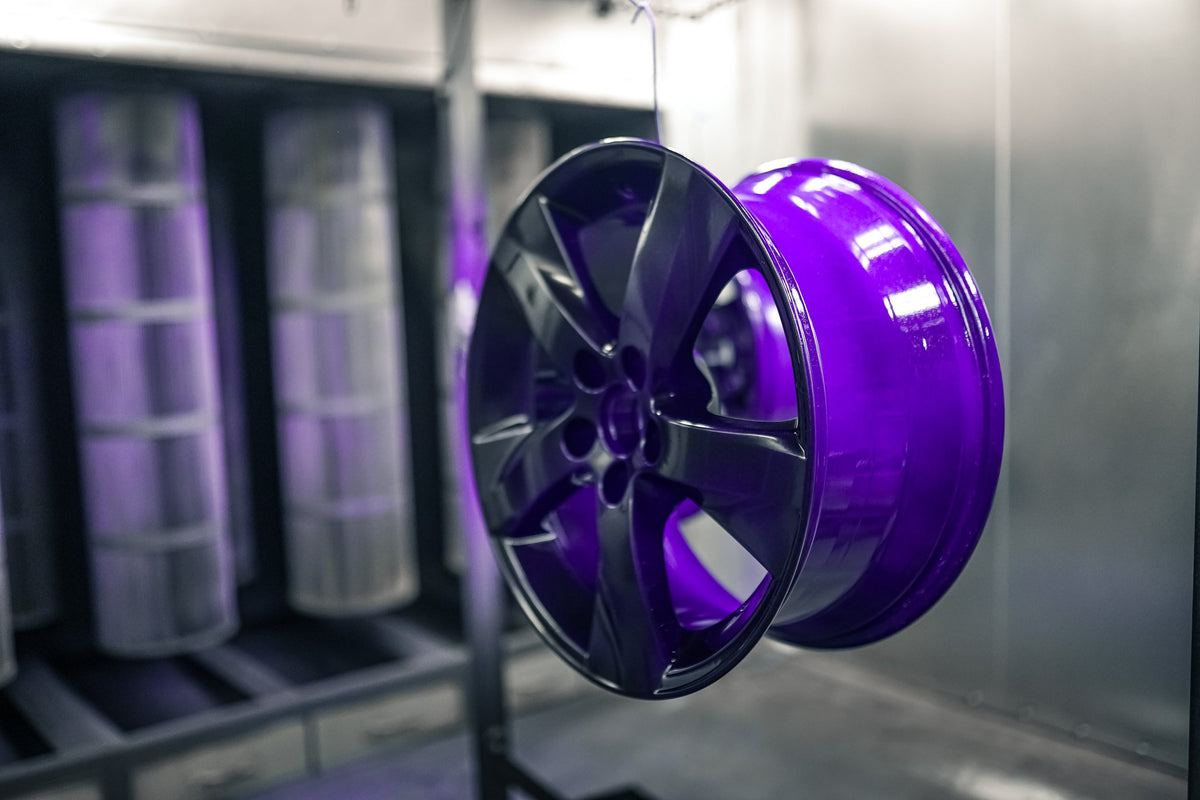
Chromatique prepares and coats your metal parts in Anjou, in Montreal’s east end. Electrostatic powder coating is most of what we do; sandblasting and chemical cleaning prepare your parts.
Main service
Electrostatic powder coating
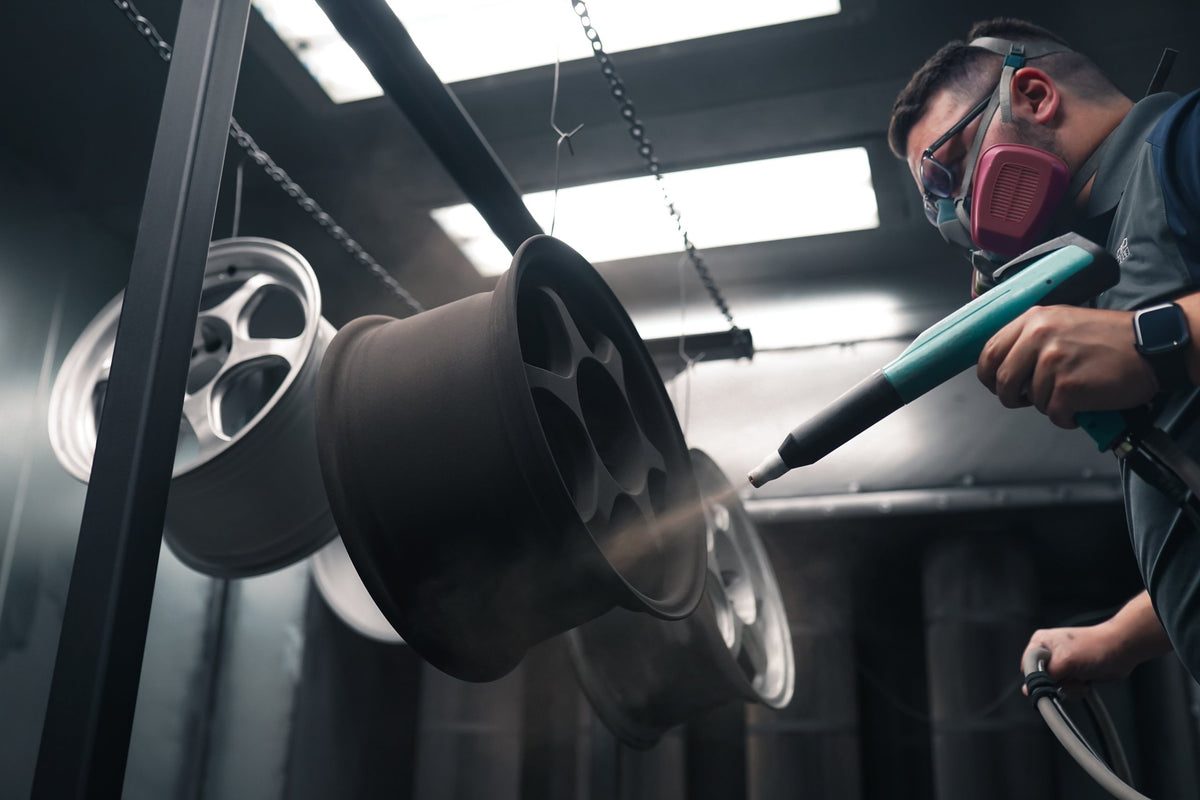
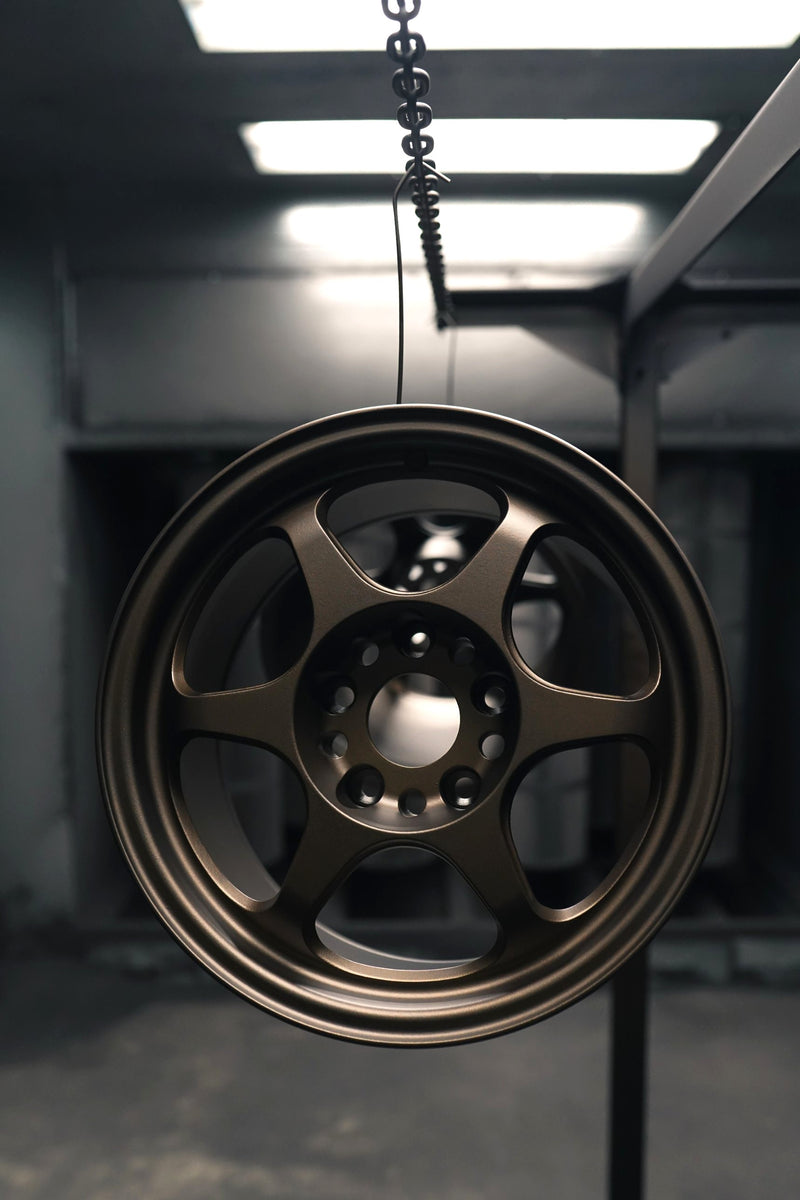
The powder is sprayed dry onto the part, where it clings by electrostatic charge, then it is cured in the oven. That is why it is also called electrostatic painting or baked-on powder paint. The result is a thick, even film that resists chips, corrosion and scratches better than ordinary liquid paint.
We coat anything that can be powder coated: steel, aluminum, stainless steel, cast iron and galvanized steel, from a single part to a production run.
- BASF pretreatment on every job: Ardrox degreaser, rinse, Gardobond zirconium dried in place
- Standard two-coat finish: colour coat and clear top coat
- Primer or third coat when needed, for transparent effects
- Masking of threads, mating surfaces and bearing seats as you specify
- Cure in our GFS oven: usable space 9 ft wide, 11 ft deep and 9 ft high
- Two booths as large as the oven, Gema OptiFlex and MS Elite M5 guns
Finishes offered
Five finishes, thousands of colours
Each finish comes in a wide range of colours. Our suppliers’ catalogues help you choose.
Solid
A full, even colour, in gloss, satin or matte. The most common choice.
Metallic
Flakes in the powder add sparkle and depth. A clear top coat protects them.
Transparent
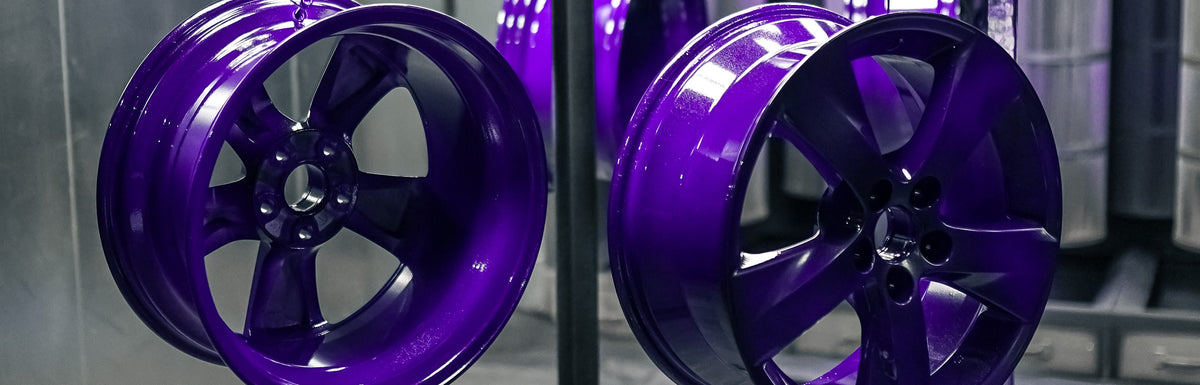
A translucent colour laid over a bright base, for the “candy” effect that is popular on wheels.
Textured
A fine or coarse grain that hides small flaws in the metal and stands up well to marks.
Wrinkle
A wrinkled texture, widely used on valve covers and engine parts.
RAL colours
Give us a RAL code and we order the matching powder. Handy for matching existing parts.
What we coat
From wheels to production parts
A few examples of the parts we coat.
Wheels and rims
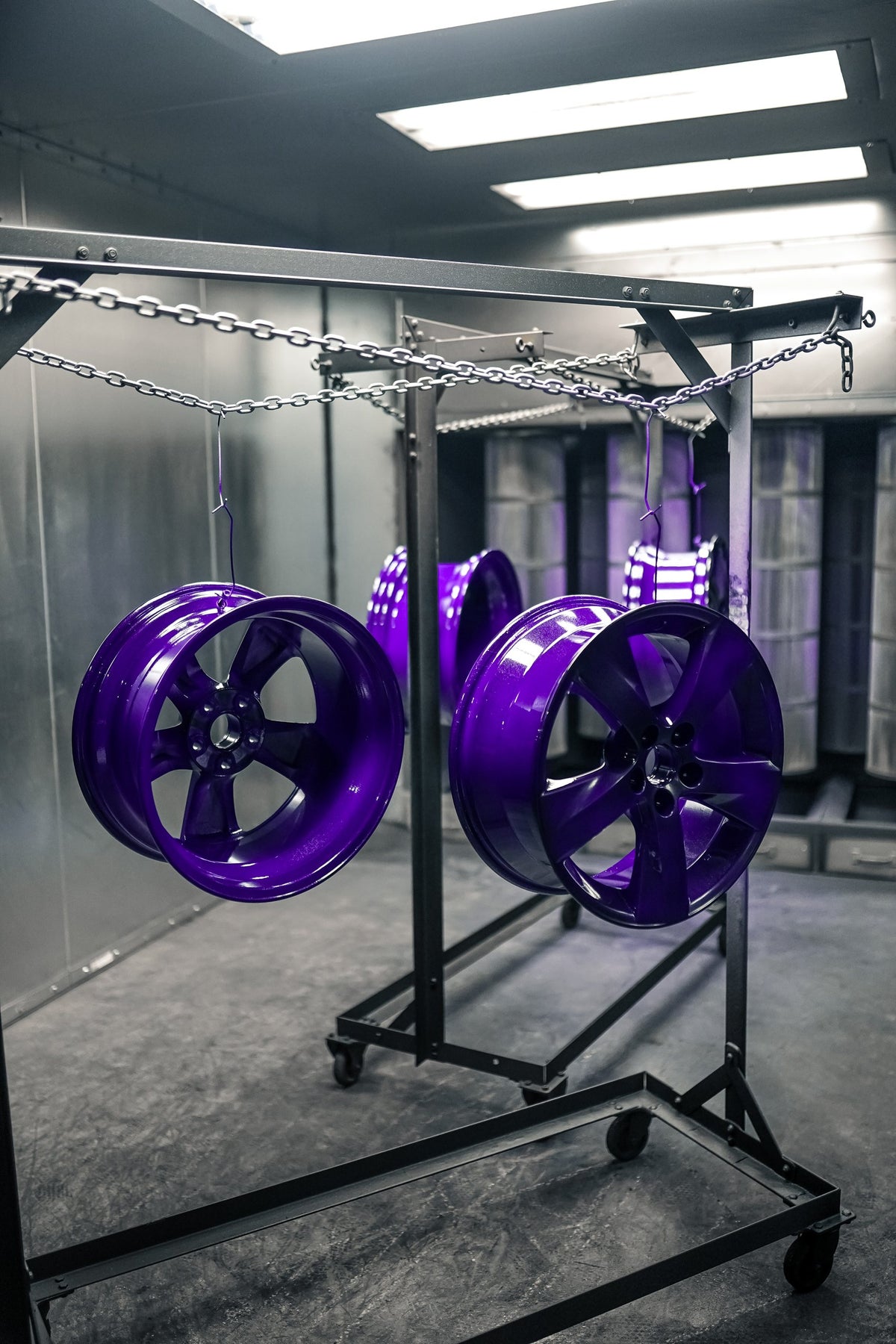
Alloy wheels (mags) or steel rims, brought in without tires.
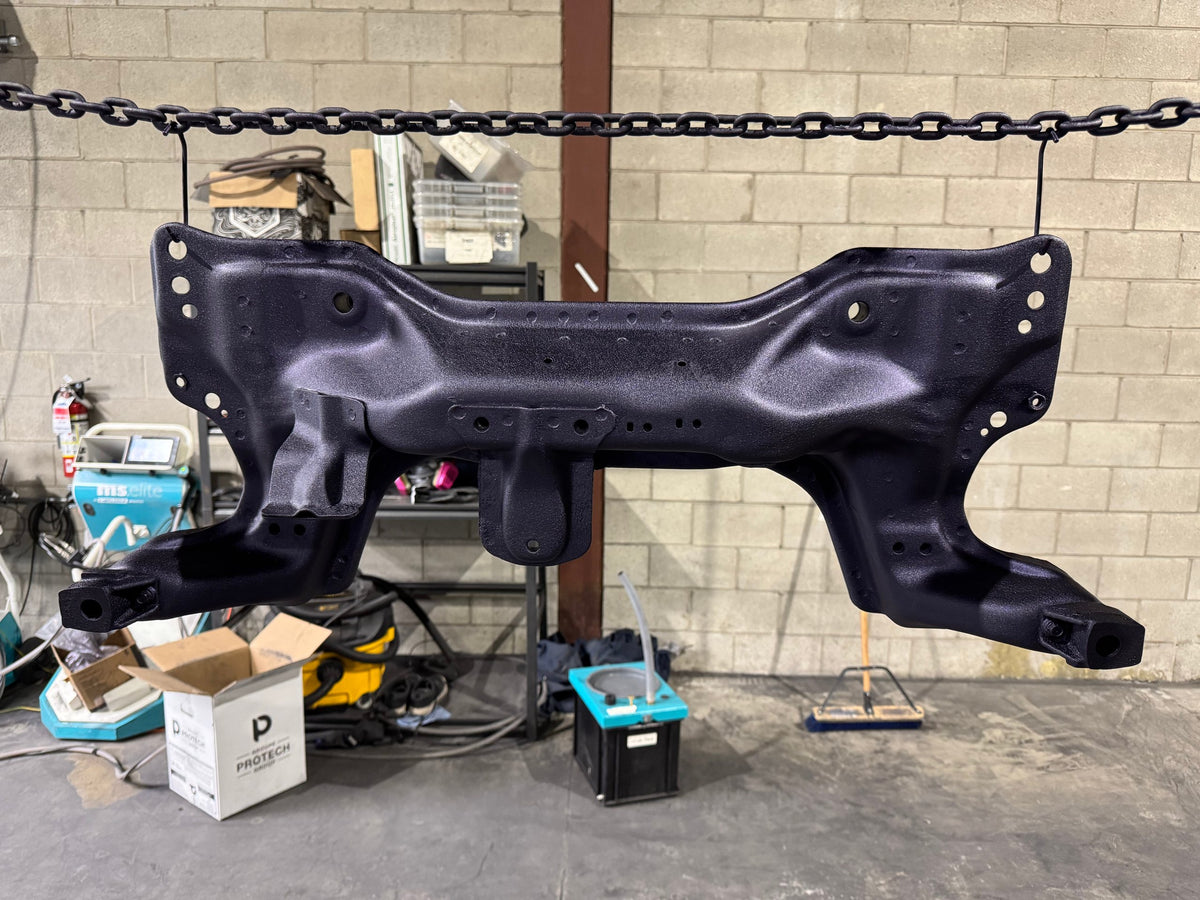
Automotive parts
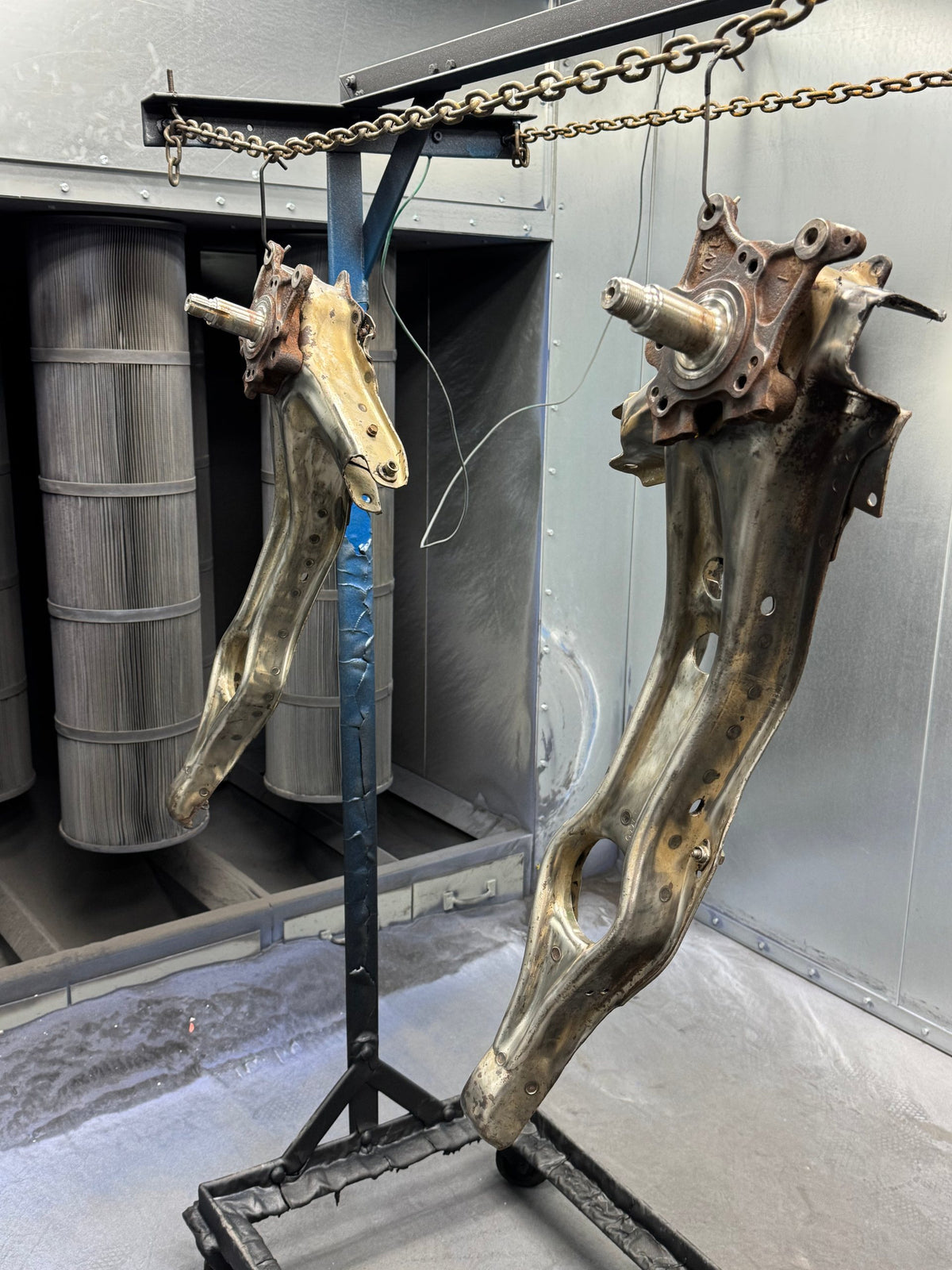
Subframes, control arms, knuckles, valve covers.

Aluminum extrusions
Long extrusions coated on racks, by a team that has been coating aluminum extrusions for three years.

Sheet metal and panels
Panels, enclosures and bent parts.
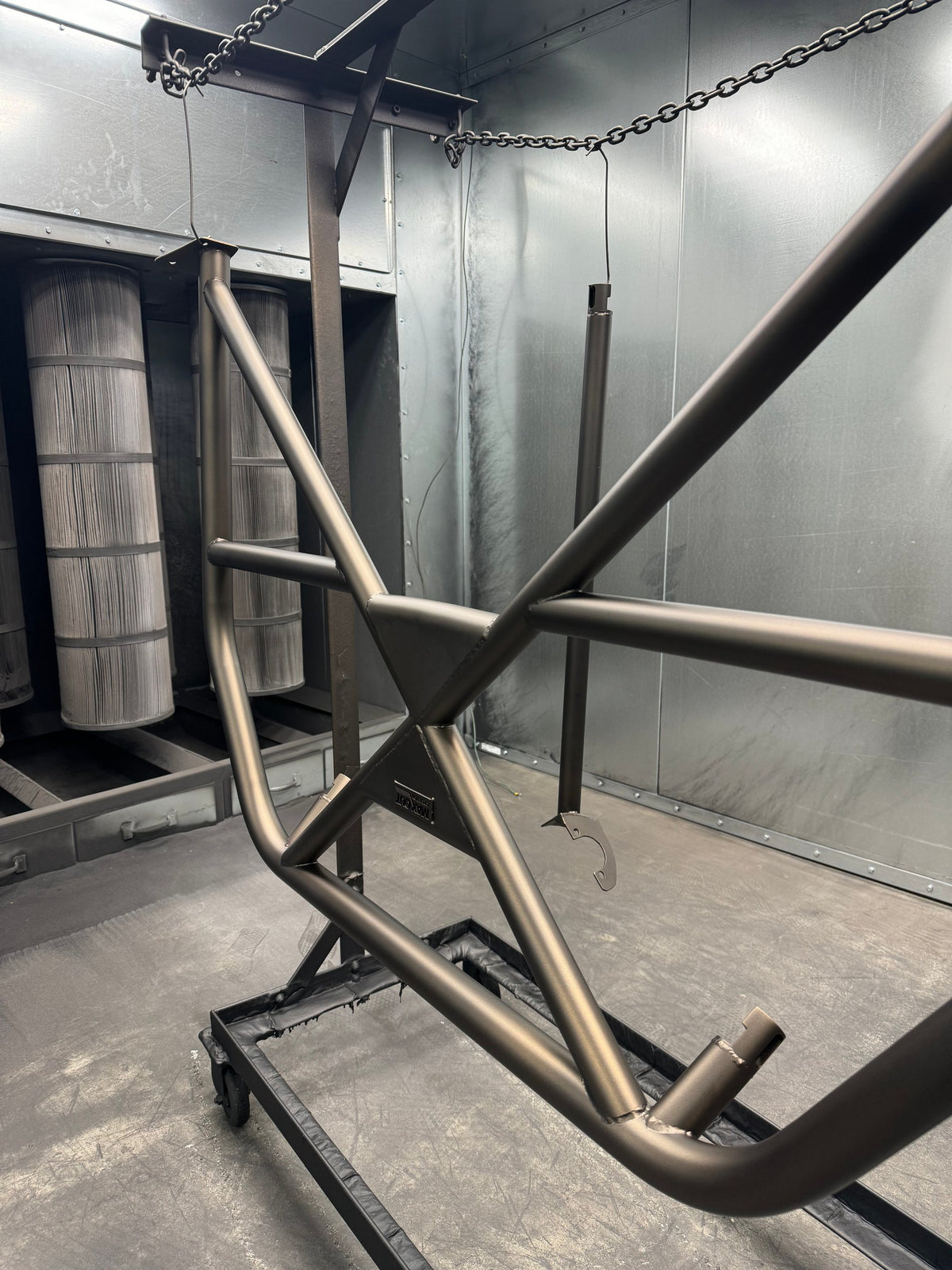
Tube frames
Chassis and welded structures.
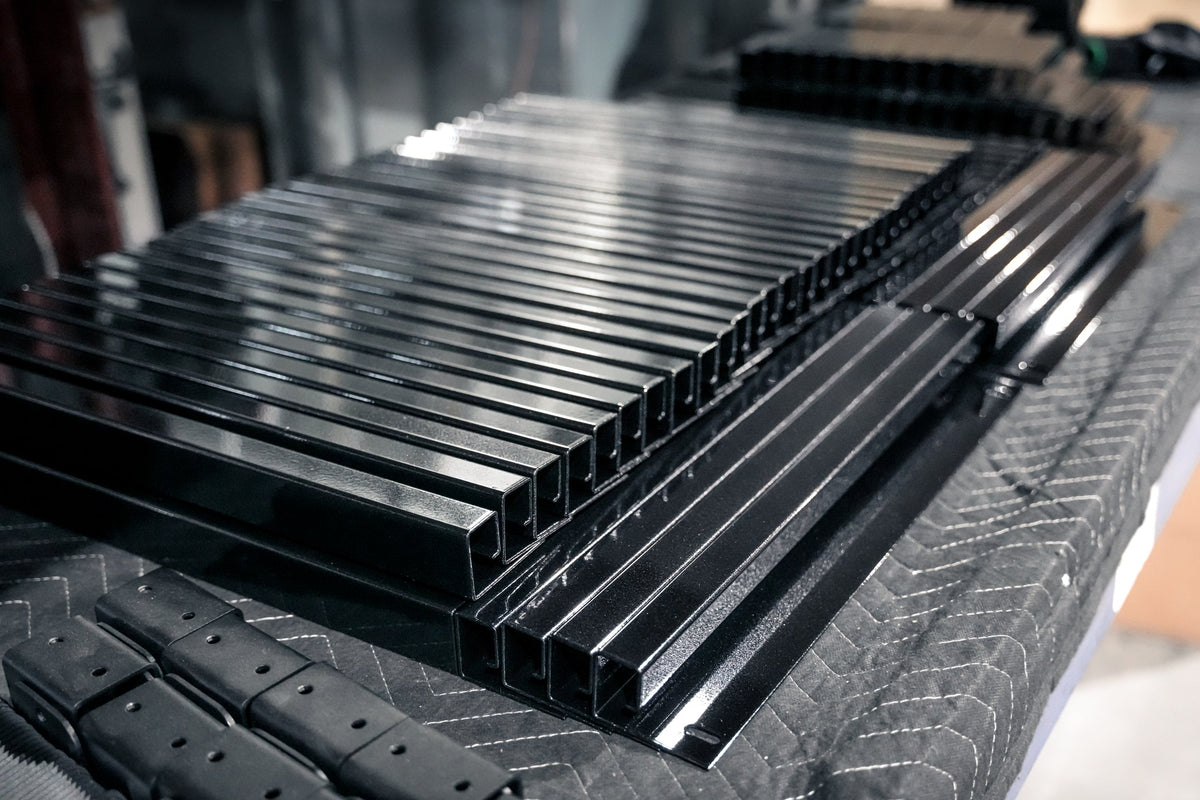
Production parts
Recurring batches, up to about twenty small parts per rack.
Free quote
Order your quote online
Prefer to go through the store? Choose the size and type of project, describe your parts, then complete the order. The total is $0: we receive your contact details and reply in less than 24 hours, on business days.
- Order total: $0
- Reply in less than 24 hours, on business days
- No obligation on your part
Choose the free quote product in the section settings.
Surface preparation
Sandblasting
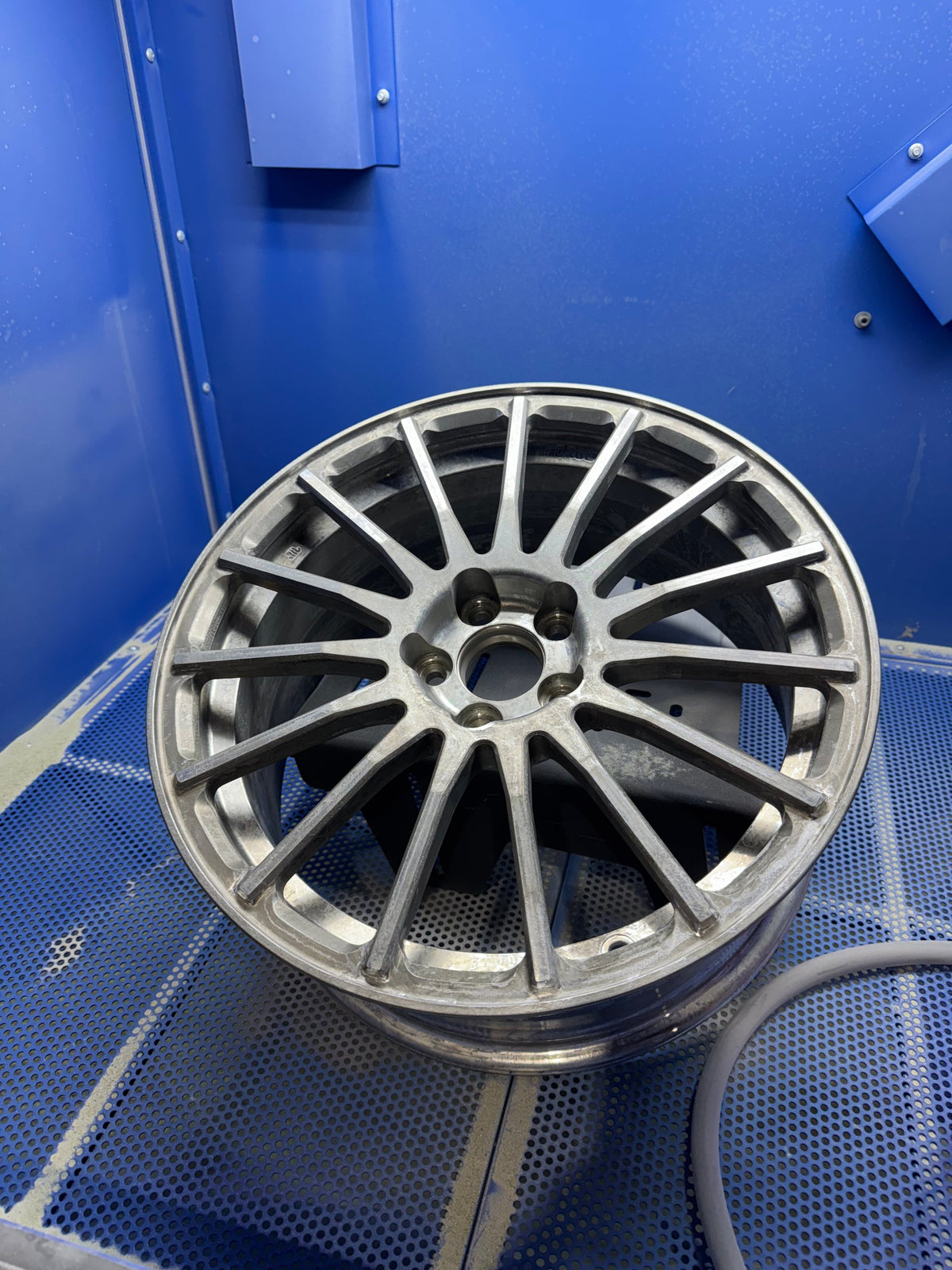
New powder only holds on clean metal. Sandblasting, also called abrasive blasting, fires an abrasive at the part to remove rust, mill scale and old coatings, and to create a surface profile that helps the powder bond.
We offer it as preparation before powder coating, or as a separate service if you only want a part taken back to bare metal.
Blasting is done in our sandblasting cabinet, which has a usable space of 30 in deep × 30 in wide × 26 in high (76 × 76 × 66 cm): that is the largest part size we can blast. For a larger part, contact us.
- Removes rust and corrosion
- Removes old paint and powder coat
- Surface ready for pretreatment
- Parts up to 30 × 30 × 26 in (76 × 76 × 66 cm)
Surface preparation
Chemical cleaning
Cutting oils, grease and machining residue stop the powder from bonding. Chemical cleaning removes them with BASF products: Ardrox degreaser is sprayed on, the part is rinsed, then Gardobond, a zirconium conversion treatment, is sprayed on in turn and dries in place, with no final rinse.
This treatment is part of every powder coating job. It is also offered on its own, for parts that need to be clean before another operation.
- Ardrox degreaser (BASF) sprayed on, then rinsed
- Gardobond zirconium conversion (BASF), dried in place
- Better adhesion, better corrosion resistance
Frequently asked questions
26 questions about powder coating
The answers we give most often on the phone, put in writing.
What is powder coating and how does it work?
Powder coating is a finish applied dry, with no solvent. The powder, made of resin and pigments, picks up an electric charge in the spray gun. The metal part is grounded, so the powder clings to it evenly, even in recesses.
The part then goes into the oven. Heat melts the powder, which hardens into a continuous film that is thicker and tougher than ordinary liquid paint. At Chromatique, every part is first degreased, rinsed and pretreated with zirconium so the finish bonds well.
Powder coating, electrostatic painting, baked-on paint: are they the same thing?
In everyday use, yes: all three describe the same process. “Powder coating” names the product, “electrostatic painting” describes how the powder is drawn to the part, and “baked-on paint” describes the oven cure that hardens the finish. In French you will see peinture en poudre, peinture électrostatique or peinture au four.
One distinction: some companies use “electrostatic painting” for liquid paint sprayed on site, for example on office furniture or lockers. That is not our process. At Chromatique, parts come to the shop, the powder is applied in a booth, then cured in our oven.
Powder coating or liquid paint: which should I choose?
For a metal part that has to last, powder coating is usually the better choice. The film is thicker, it stands up better to chips, scratches and corrosion, and it contains no solvent.
Liquid paint still has its place in three cases: the part cannot take the heat of the oven (plastic, rubber, glued assemblies), it is too large to fit in an oven, or the work has to be done on site. If you are unsure, describe the part and how it will be used in your quote request: we will tell you plainly what suits it.
How long does a powder-coated finish last?
A properly applied powder coat lasts for many years. Three things decide how long: surface preparation, the type of powder and the environment the part will be used in.
Preparation matters most. Powder applied to poorly cleaned metal ends up peeling, whatever its quality. That is why we degrease, rinse and pretreat every part with zirconium before coating. For a part exposed to sun, salt or impacts, say so in your request: the choice of powder and the number of coats will take it into account.
Which metals and parts can be powder coated?
Any metal that conducts electricity and can take the heat of the oven can be powder coated: steel, aluminum, stainless steel, cast iron and galvanized steel.
In the shop, we coat wheels, automotive parts (subframes, control arms, knuckles, valve covers), aluminum extrusions, sheet metal, tube frames and production parts for manufacturers, among others. Our rule is simple: if a part can be powder coated, we coat it. Email us a photo and the dimensions to confirm.
What cannot be powder coated?
Anything that cannot take the heat of the oven or does not conduct electricity: plastic, rubber, wood, and parts containing seals, bearings, electronic components or body filler.
So a part has to arrive disassembled. For wheels, that means no tires, no valves, no pressure sensors and no wheel weights. Parts larger than our oven and booths (usable space 9 ft wide, 11 ft deep and 9 ft high) cannot be done either: give us the dimensions of the largest part and we will confirm.
How much does powder coating cost?
The price depends on five things: the size of the parts, the quantity, the preparation needed (sandblasting, stripping an old coating), the colour and number of coats, and the masking required.
So two parts of the same size do not always cost the same. A new part in bare metal takes less work than a rusted or previously painted one, and a three-coat finish takes longer than a solid colour.
The minimum order is $350 before taxes. The quote is free. Fill in the quote request with the type of parts, the quantity, the dimensions and the colour you want: you get a price in less than 24 hours.
How much does it cost to powder coat a set of wheels or rims?
The price for a set of four wheels depends on their diameter, their condition and the finish chosen. Wheels that are already painted or corroded have to be stripped before coating, which adds work. A metallic or transparent finish in several coats takes more work than a solid colour.
In every case, the wheels must arrive without tires, valves, sensors or wheel weights. For an exact price, give the diameter, the current condition and the colour you want in the quote request, and email us a photo. You will have a reply in less than 24 hours.
Which payment methods do you accept?
We accept major credit cards, cash and Interac e-Transfer. Payment is made when you pick up your parts.
Businesses can also open a 30-day account: see the next question.
Do you offer 30-day accounts to businesses?
Yes. We offer business accounts payable in 30 days (NET 30), subject to a credit check, once your orders reach the $10,000 threshold before taxes. Until then, payment is made when you pick up your parts.
How long does it take to get my parts coated?
Our standard turnaround is 5 business days per order. Rush orders can be done in 1 to 2 business days, with a rush fee, when the colour is in stock. A large order with custom colours and several coats takes 10 to 15 business days.
A special colour that is not in stock at our suppliers has to be ordered, which can add time. You get your quote in less than 24 hours (business days), whatever the complexity of the project, with a realistic timeline: if a date or a request is beyond what we can do, we tell you right away. If you have a deadline, enter it in the form.
What is the largest part you can coat?
Part size is limited by the usable dimensions of our cure oven and our two application booths: 9 ft wide, 11 ft deep and 9 ft high (about 2.7 m × 3.35 m × 2.7 m). The part has to fit inside completely, hanging from its rack. Weight matters too, since the part is hung.
Sandblasting has its own limit: it is done in a cabinet with a usable space of 30 in deep × 30 in wide × 26 in high (76 × 76 × 66 cm). A larger part can be coated, but not blasted in our shop; contact us to discuss it.
For a large part, give us its length, width, height and approximate weight in the quote request. We will confirm whether it fits. Long aluminum extrusions and tube frames are among the parts we coat.
Which colours and finishes are available?
Almost every colour exists as a powder. We work with the catalogues of Prismatic Powders, Protech, Erie Powder Coatings and TIGER Coatings, among others, as well as RAL colours.
For finishes, you can choose solid, metallic, transparent, textured or wrinkle, in gloss, satin or matte. Our standard finish is a colour coat plus a clear top coat; a primer or a third coat is added when needed.
See the Colours and suppliers page to browse the catalogues, then give us the name or code of the colour.
Can you match a specific colour or a RAL code?
Yes for RAL codes: most are available as powder, and all we need is the number (for example RAL 9005 for a black).
For a colour without a code, send us a photo, a sample or the name of the shade in a supplier’s catalogue. We then look for the closest powder among those that exist. Powder is made in a factory and is not mixed in the shop like liquid paint, so the match can be very close without being perfect. We will tell you before we start.
How should I prepare my parts before bringing them in?
Bring parts disassembled, with everything that cannot take heat removed. Take off tires, valves, sensors, bearings, seals, rubber bushings, stickers and plastic parts.
You do not need to clean the metal yourself: degreasing and pretreatment are part of our process. Do tell us three things: what is on the part now (paint, powder, chrome, rust), the areas not to coat (threads, mating surfaces, bearing seats) and how the part will be used. This saves us surprises and saves you extra cost.
Do you remove old paint, rust or old powder coat?
Yes. New powder has to go on clean metal, so the old coating and the rust must be removed before coating. That is what sandblasting is for.
Sandblasting removes rust, mill scale and old coatings with a blasted abrasive, and leaves a surface that helps the powder bond. It is done in our sandblasting cabinet, for parts up to 30 in deep × 30 in wide × 26 in high (76 × 76 × 66 cm); for a larger part, contact us. Chemical cleaning then removes oils, grease and residue. We assess the condition of your parts when we quote and tell you the preparation needed, with its price.
What is pretreatment and why does it matter?
Pretreatment is the chemical preparation of the metal before coating. At Chromatique it uses BASF products, in four stages: Ardrox degreaser sprayed on, rinse, Gardobond zirconium treatment sprayed on, then drying in place, with no final rinse.
Zirconium forms a thin conversion layer on the surface of the metal. That layer improves powder adhesion and slows corrosion if the finish is ever chipped. Most finishes that flake or blister have one thing in common: a poorly prepared surface. It is the step you do not see, and the one that matters most.
Can you mask threads, bearing seats and mating surfaces?
Yes. Before application, we mask the areas that have to stay bare metal: threads, tapped holes, bearing seats, mating surfaces and grounding points.
A powder coat adds thickness. On a thread or a fitted surface, that thickness can prevent assembly. So mark the areas to protect in your quote request, and email us a photo or a drawing if needed. The masking you ask for is included in the quote.
What is a three-coat finish or a clear coat, and when do I need one?
A three-coat finish stacks a metallic base, a colour coat and a clear coat. That is how deep “candy” colours are made: a bright metallic base, then a transparent colour that lets the base show through, then the clear.
The clear coat, applied last, protects the colour and adds depth. It is recommended on metallic finishes, which can dull without protection. Our standard finish is a colour coat plus a clear top coat: two coats are enough for a solid colour. For a transparent or very deep effect, it takes three.
Does powder coating stand up to heat, sun and road salt?
On the whole, yes, and better than ordinary liquid paint. A properly cured powder coat forms a continuous barrier against moisture and salt, which makes it a good choice for wheels or chassis parts used through a Quebec winter.
Two limits to know. Extreme heat: a standard powder is not suitable for exhaust parts. Sun: not all powders resist UV equally, and a powder made for outdoor use has to be chosen. Tell us where the part will be used and we will choose the powder accordingly.
Can a powder-coated part be repaired or recoated?
Yes. A small chip can be touched up with liquid paint in the same colour, which protects the metal without redoing everything. The touch-up does stay visible up close.
For an even result, the part has to be stripped and fully recoated. A new coat can also be applied over an existing powder coat if it is in good condition and well prepared. We assess the part before deciding: email a photo of the damage to info@chromatique.ca.
Do you take single parts from individuals as well as production runs?
Yes. We work with individuals who bring in four wheels or one automotive part, and with manufacturers who send us recurring runs. The process is the same in both cases: pretreatment, application, cure.
We run three batches a day, about 66 a month, and can double that capacity with an evening and night shift. Our 40 rolling racks take almost any shape of part, or batches of small parts, about twenty per rack.
In the quote form, enter the quantity and choose “one-time order” or “recurring order”. For a production run, give the expected volume per month or per year: it lets us plan the racks and offer you a suitable price.
Where are you located and which areas do you serve?
The shop is at 10301 Ray-Lawson Blvd., Suite C, in Anjou, in Montreal’s east end, near highways 25 and 40. We are open Monday to Friday, 8 a.m. to 4 p.m.
We serve all of Greater Montreal: the Island of Montreal, Laval, Longueuil, the North Shore and the South Shore. You can drop off your parts at the shop during opening hours. For any question, call us at (450) 400-7007 or write to info@chromatique.ca.
Do you offer pickup and delivery of parts?
Yes. You can drop off your parts at the shop during business hours, or we arrange pickup and delivery on demand through our transportation partners, anywhere in Quebec. Just mention it in your quote request.
How will I know my parts are ready?
You get an automatic notice by email and text message as soon as your order is ready for pickup or delivery.
Can you load and unload heavy or bulky parts?
Yes. The shop has a ground-level garage door and an all-season forklift that loads and unloads any type of vehicle: pickup truck, box truck, flatbed or 53-foot trailer.
Free quote
Got a part to coat? Let’s talk.
Describe your parts in two minutes. We reply in less than 24 hours, on business days.