Lit powder coating booth with wheels hanging beside it

News

Tips, projects and news from the shop

Powder coating, surface preparation, colours and recent work from Chromatique, in Montreal.
News

How long does powder coating last? What the standards measure

One year, five years or ten years of exposure in Florida: the AAMA and Qualicoat standards rank finishes by how well they hold up in the sun. Here is how to read them.

How artificial intelligence could improve powder coating

Software already adjusts guns based on thickness measurements taken before curing. What artificial intelligence does in powder coating today, what it promises, and what remains to be proven.

Low temperature powders: curing cooler, the long-term trend

Powders that cure at 150 °C, or even 120 °C, and a laser curing project: manufacturers are going after the oven's energy consumption. A look at what has been announced, and what has been proven.

Powder coating wood, plastic and 3D printed parts

Powder coating is moving beyond metal. Very low temperature powders and UV-cured powders make it possible to coat MDF, plastics and 3D printed parts. Here is where things stand.

Electric vehicle batteries: when powder becomes an insulator

In an electric vehicle battery, powder coating is no longer there to decorate but to insulate. AkzoNobel, PPG and Axalta have launched dielectric powders. An overview.

Maintaining a powder coated surface: the simple guide

Lukewarm water, a mild soap, a cloth: maintaining a powder coat finish is simple. Here is what the manufacturers recommend, and what to avoid.

Greener powders: recycled plastic, PFAS-free, TGIC-free

Resins made from recycled bottles, PFAS-free additives, the announced end of TGIC: how manufacturers are reformulating powder coating, and what their numbers are worth.

RAL colours: how to read a code and choose your shade

RAL 9005, RAL 7016, RAL 3020: these four-digit codes let you order exactly the same colour anywhere. Where they come from, how to read them and the pitfalls to avoid.

Powder coating, anodizing or galvanizing: which to choose?

Three ways to protect metal, three different approaches. What powder coating, anodizing and galvanizing do, and when to combine them.

Robots and part detection: where booth automation stands

Systems that recognize each part, robots that learn the painter's motion, and a Laval startup that tried the autonomous robot: an update on powder coating automation.

How the quality of a powder coating is checked

Thickness, cure, adhesion, salt spray: the tests used to judge a powder finish, what each one measures, and what it does not prove.

Epoxy, polyester, hybrid: which powder for which part?

Not all powders are equal. Epoxy, polyester, hybrid, polyurethane, fluoropolymer: what each family is for and which one suits your part.

Road salt and corrosion: protecting metal from Quebec winters

Montreal spreads an average of 150,000 tonnes of salt per winter. What that salt does to steel and aluminum, and how a well-prepared powder coat finish stands up to it.

Zirconium pretreatment: the invisible step that makes the finish last

A layer a thousand times thinner than a hair, laid down before the powder, decides how well the finish adheres. Here is what zirconium pretreatment is and why we use it.

Bubbles and pinholes: outgassing in cast and galvanized parts

Small holes or blisters sometimes appear on a cast or galvanized part during curing. That is outgassing. Here is its cause and the ways to limit it.

Matte, satin, textured, candy: understanding powder coat finishes

Gloss is measured, textures hide flaws, metallics take a careful hand and a candy is built up in several coats. The guide to powder finishes.

The Faraday cage effect: why powder avoids recesses

Charged powder settles readily on edges and shuns inside corners. That is the Faraday cage effect. Here is where it comes from and how an applicator works around it.

Powder coating and the environment: zero solvent, and Quebec's rules

A powder contains no solvent and emits practically no volatile organic compounds. Here is what that changes, what the Quebec regulation provides, and what still needs to improve.

Sandblasting before painting: why surface profile matters

Sandblasting does more than clean: it creates the texture the paint grips. Cleanliness grades, profile, abrasive choice and flash rust, explained.

Powder coating or liquid paint: the real advantages, and the limits

A thicker film in one coat, no solvent, less waste: what powder coating does better than liquid paint, and the cases where liquid keeps the edge.

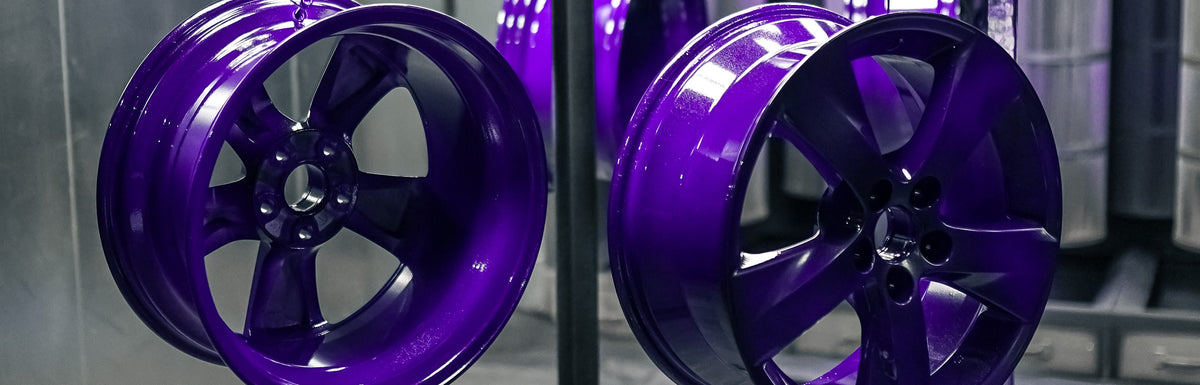
Two wheels powder coated in gloss purple hanging side by side

Free quote

Got a part to coat? Let’s talk.

Describe your parts in two minutes. We reply in less than 24 hours, on business days.